You've probably heard it takes 21 days to form a habit. This popular belief has launched countless challenges and programs promising transformation in just three weeks. But here's the truth: habit formation is far more complex, individual, and fascinating than any arbitrary timeline suggests.
Where Did 21 Days Come From?
The 21-day myth originated from a 1960s observation by plastic surgeon Maxwell Maltz. He noticed his patients took about 21 days to adjust to their new appearance after surgery. Somehow, this observation morphed into a universal "rule" about habit formation. But adjusting to a new nose isn't the same as building a consistent exercise routine.

The Real Science: 66 Days (On Average)
Research from University College London studied actual habit formation and found it takes an average of 66 days for a behavior to become automatic. But here's the kicker: the range was 18 to 254 days. That's right – some habits formed in less than three weeks, while others took over eight months.
The variation depends on:
- Complexity of the habit (drinking water vs. doing 50 push-ups)
- Individual differences (your personality, lifestyle, and motivation)
- Environmental factors (support system, available resources)
- Consistency of practice (daily vs. sporadic attempts)
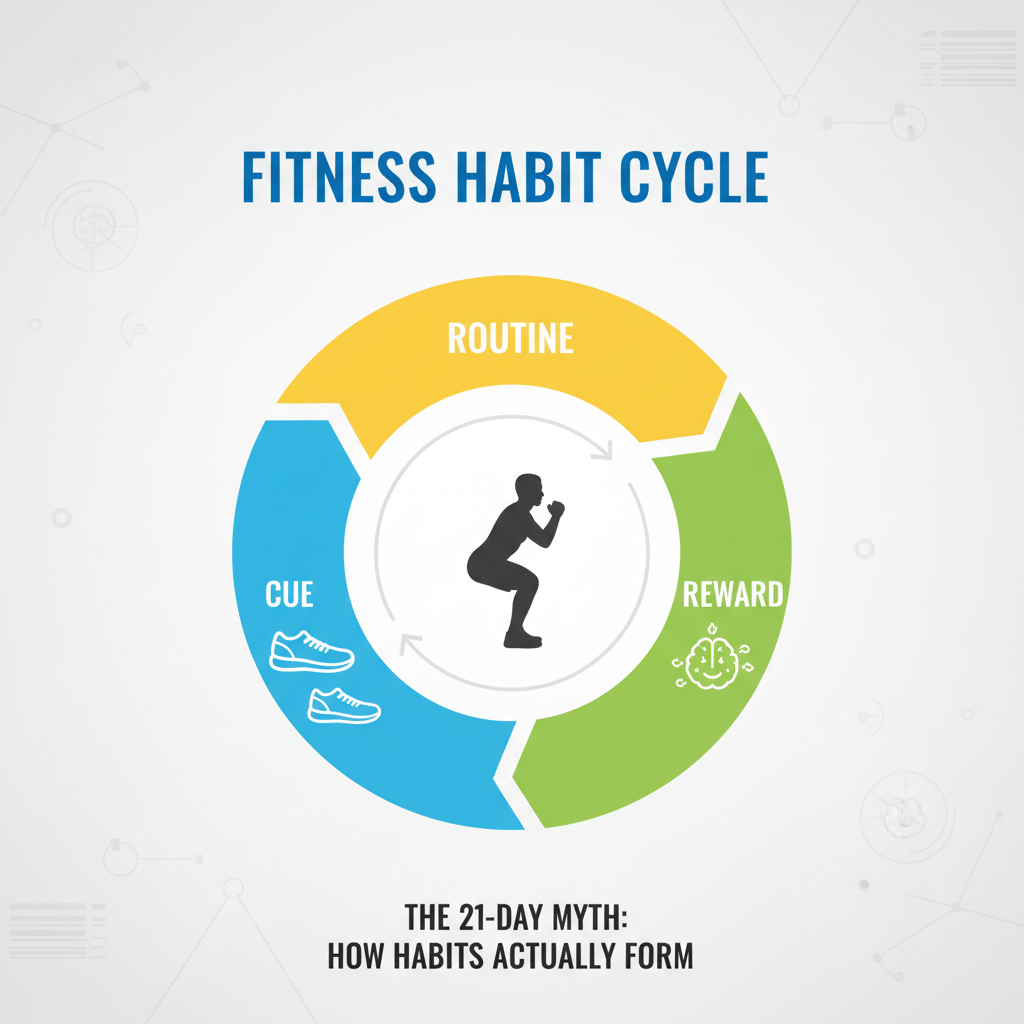
Understanding the Habit Loop

Every habit follows a neurological pattern called the habit loop:
1. Cue (The Trigger)
This is what initiates the behavior. For fitness, it might be:
- Setting out workout clothes the night before
- An alarm labeled "gym time"
- Coming home from work (transition cue)
- Seeing your running shoes by the door
2. Routine (The Behavior)
This is the habit itself:
- The actual workout
- Walking around the block
- Doing ten squats
- Stretching for five minutes
3. Reward (The Payoff)
This reinforces the loop:
- Endorphin rush
- Sense of accomplishment
- Checking off your workout tracker
- Post-workout smoothie
Why Some Habits Stick Faster Than Others
Easy Habits (18-30 days)
- Drinking a glass of water upon waking
- Doing five push-ups before shower
- Taking vitamins with breakfast
- Walking for 10 minutes after lunch
These form quickly because they're simple, require minimal effort, and easily attach to existing routines.
Moderate Habits (30-60 days)
- 20-minute morning workouts
- Preparing healthy lunches
- Going to bed at consistent time
- Weekend gym sessions
These need more planning and effort but aren't overwhelming.
Complex Habits (60-250 days)
- Daily hour-long workouts
- Complete dietary overhaul
- Training for specific athletic goals
- Morning person transformation (if you're naturally a night owl)
These require significant lifestyle changes and mental rewiring.

The Missing Piece: Identity Change
Here's what most habit advice misses: lasting habits aren't just about behavior change – they're about identity change. Instead of "I'm trying to exercise," successful habit-formers think "I'm someone who exercises."
This identity shift happens through:
- Small wins that prove you can do it
- Consistent repetition that makes it feel normal
- Social reinforcement from others seeing you as "that person"
- Internal narrative changing from "have to" to "want to" to "this is who I am"
Practical Strategies That Actually Work
1. Start Ridiculously Small
Forget the perfect workout plan. Start with:
- One push-up
- One minute of stretching
- Walking to the end of your street
Once it's automatic, then increase. The goal is consistency, not intensity.
2. Use Implementation Intentions
Instead of vague goals, use this formula: "I will [BEHAVIOR] at [TIME] in [LOCATION]"
Example: "I will do 10 squats at 7 AM in my bedroom"
This increases success rates by 2-3x according to research.
3. Stack Your Habits
Attach new habits to existing ones:
- After I pour my morning coffee, I'll do five stretches
- After I brush my teeth, I'll do ten squats
- After I eat lunch, I'll walk for five minutes

4. Design Your Environment
Make good habits obvious and easy:
- Keep workout clothes visible
- Put healthy snacks at eye level
- Hide your phone during workout time
- Keep water bottle on your desk
5. Track Without Judgment
Use a simple calendar or app to mark successful days. But here's the key: missing one day doesn't break the chain. Research shows missing a single day has no impact on long-term habit formation. It's the second miss that's dangerous.
The Two-Day Rule
Never miss twice. Life happens – you'll get sick, travel, or have emergencies. Missing once is normal. Missing twice starts forming a new pattern (the wrong one). If you miss Monday, make Tuesday non-negotiable.
Common Pitfalls and How to Avoid Them
Pitfall 1: All-or-Nothing Thinking
Problem: "I must do a perfect hour workout or it doesn't count" Solution: Something is always better than nothing. A five-minute walk maintains the habit.
Pitfall 2: Too Many Habits at Once
Problem: Trying to overhaul your entire life simultaneously Solution: Focus on one keystone habit that naturally triggers others (like morning exercise often leads to better eating).
Pitfall 3: Relying on Motivation
Problem: Waiting to "feel like it" Solution: Make the habit so easy you can do it even on your worst day.
Pitfall 4: Ignoring Your Chronotype
Problem: Forcing morning workouts when you're a night person Solution: Work with your natural rhythms, not against them.

The Plateau of Latent Potential
Here's something nobody talks about: habits often feel like they're not working for weeks before suddenly clicking. James Clear calls this the "Plateau of Latent Potential." You're putting in effort but not seeing results... until one day, it all comes together.
Think of it like melting ice:
- At 25°F, nothing happens
- At 30°F, still nothing
- At 31°F, still ice
- At 32°F, suddenly it melts
Your effort wasn't wasted at 25°F – it was all necessary to reach the breakthrough.
Making It Personal: Find Your Formula
Forget the 21-day myth. Your habit formation timeline depends on:
- Your starting point (fitness level, available time, resources)
- The specific habit (complexity and required effort)
- Your support system (accountability partners, environment)
- Your approach (gradual vs. intense, morning vs. evening)
- Your personality (responds better to rewards vs. consequences)
The Truth About Automaticity
Even "automatic" habits require some conscious effort. You still have to put on your running shoes. The difference is it stops feeling like a decision and starts feeling like "just what you do."
Signs a habit is becoming automatic:
- You do it without internal negotiation
- Skipping it feels wrong
- You don't need reminders
- It's part of your identity ("I'm a person who...")
Your Habit Formation Action Plan
- Pick ONE fitness habit (seriously, just one)
- Make it stupidly easy to start (2 minutes or less)
- Attach it to an existing routine (habit stacking)
- Set up obvious cues in your environment
- Track it simply (just mark an X on a calendar)
- Follow the two-day rule (never miss twice)
- Expect it to take 2-8 months (not 21 days)
- Celebrate small wins along the way
Remember: you're not building a habit, you're becoming a person who does this thing. That transformation doesn't happen on a schedule – it happens through consistent, patient practice.
The 21-day myth sells programs, but the 66-day average (with its huge variation) reflects reality. Stop counting days and start focusing on systems. Your future fit self will thank you for understanding the real science of habit formation.
