
Progressive Overload: The Only Rule That Really Matters
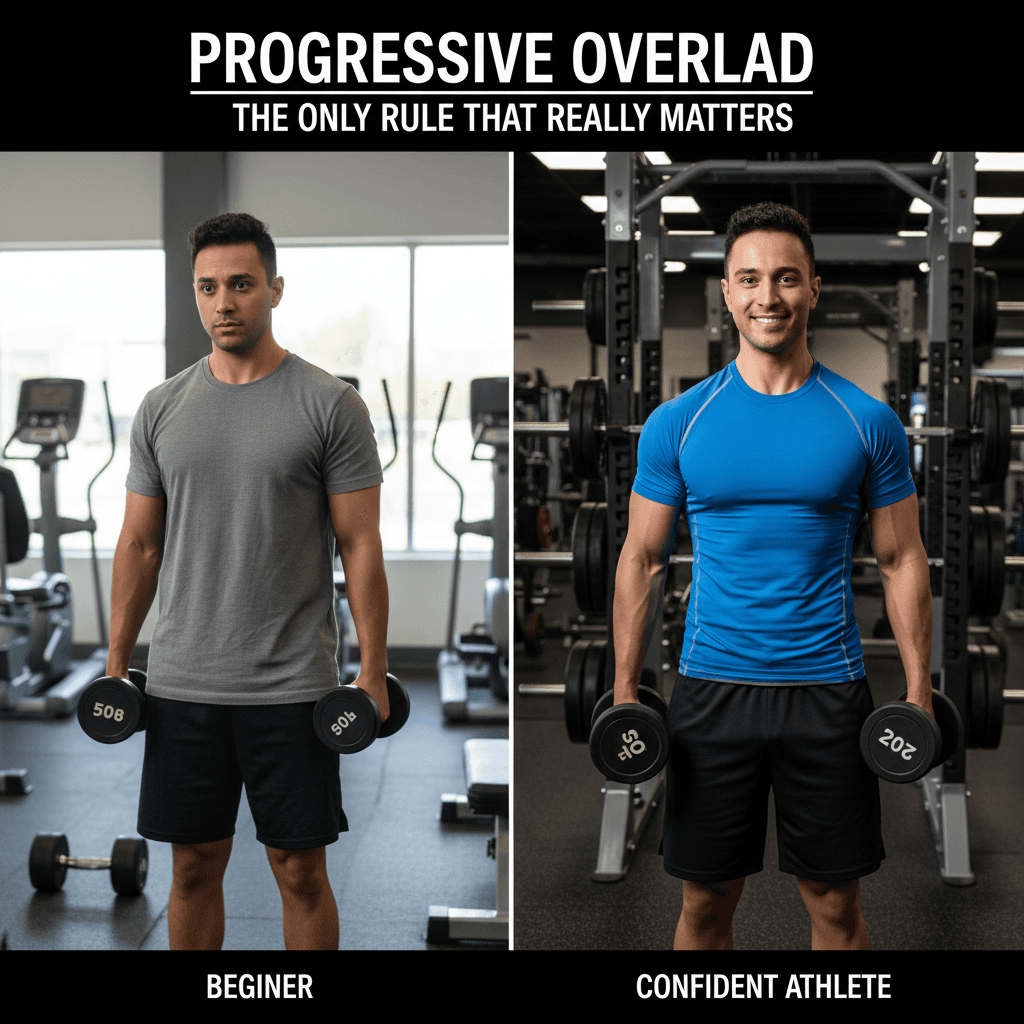
Split image showing progression: left side shows person lifting light dumbbell, right side shows same person months later lifting heavier weight with confident posture
Key Takeaways
- Progressive overload can be achieved through 6 different methods - weight, reps, sets, form, rest time, or tempo
- Track your workouts consistently and aim for small, sustainable increases rather than dramatic jumps
- Use the 2-for-2 rule or double progression method to know exactly when to increase difficulty
#What Progressive Overload Really Means
Progressive overload is the gradual increase of stress on your body during exercise over time. Challenge your body slightly beyond its current capacity and it adapts and grows stronger. Keep doing the same workout forever and it stops changing.
Here's the key insight: your body gets stronger during recovery, not during the workout itself. Workouts create the stimulus; rest creates the adaptation.
#The 6 Ways to Progress
Progressive overload is not only about adding weight. You have six options:
- Adding weight - 2.5-5 lbs for upper body exercises, 5-10 lbs for lower body
- Adding reps - aim for one more rep each session; useful when between weight increments
- Adding sets - go from 3 sets to 4 to increase total training volume
- Improving form - going deeper in squats or achieving better range of motion counts as real progress
- Decreasing rest time - shorten rest periods (e.g. 90 seconds down to 75) to increase difficulty
- Increasing time under tension - slow the lowering phase to a count of 3 before lifting
#The Goldilocks Zone for Progression
- Too little: Same weights for weeks, workouts feel easy, no real challenge
- Just right: Small, consistent increases; last 2-3 reps feel challenging; sustainable over months
- Too much: Form breaks down, joint pain, repeated plateaus
#Application Strategies
#The 2-for-2 Rule
When you can perform 2 extra reps beyond your target for 2 consecutive workouts, increase the weight. Goal of 10 reps and hitting 12 for two sessions in a row? Time to go up.
#Double Progression Method
Work on increasing reps within a range (e.g. 8-12). Once you hit the top of that range for all sets, increase the weight and drop back to the bottom of the range.
#Micro-Loading
For hard-to-progress exercises like overhead press, use 1.25 or 2.5 lb plates for tiny, consistent increments.
#What to Track
For every workout, record:
- Exercise name
- Weight used
- Sets and reps completed
- Difficulty (1-5)
- Form notes
Consistency in tracking matters more than the tool (notebook, app, or phone notes all work).
Gear for this article
Curated tools & essentials mentioned in this guide

#When Progress Stalls
Plateaus happen to everyone. Work through this checklist first:
- Ensure you're eating enough - you can't build without fuel
- Check your sleep - recovery is when growth happens
- Deload for a week - reduce weight by 40-50% to allow full recovery
- Change the stimulus - try a different progression method
#Common Mistakes to Avoid
- Form before load: Adding weight with poor form leads to injury, not progress - form always comes first
- Linear expectations: Progress isn't always linear; track trends over months, not days
- Ignoring recovery: More stress without recovery equals breakdown, not building
#The Long Game
Small, consistent increases compound over time. The person who adds 2.5 lbs every two weeks will be far stronger in a year than the person who burns out chasing 20 lbs every session.
Pick one progression method. Track every workout. Aim for small wins.
Recommended Gear
Micro-plates (0.5-2.5 lbs) enable small progressions for steady strength gains
Pre-formatted log for tracking weights, reps, and progression over time
Change weight in small increments for systematic progressive overload
Multiple resistance levels for gradual progression in any exercise
Track rest periods to progressively decrease recovery time between sets
Attach to dumbbells for small weight increases when standard plates aren't available
Support recovery between progressive workouts for continued strength gains