
What Is Your Core, and How Do You Engage It?
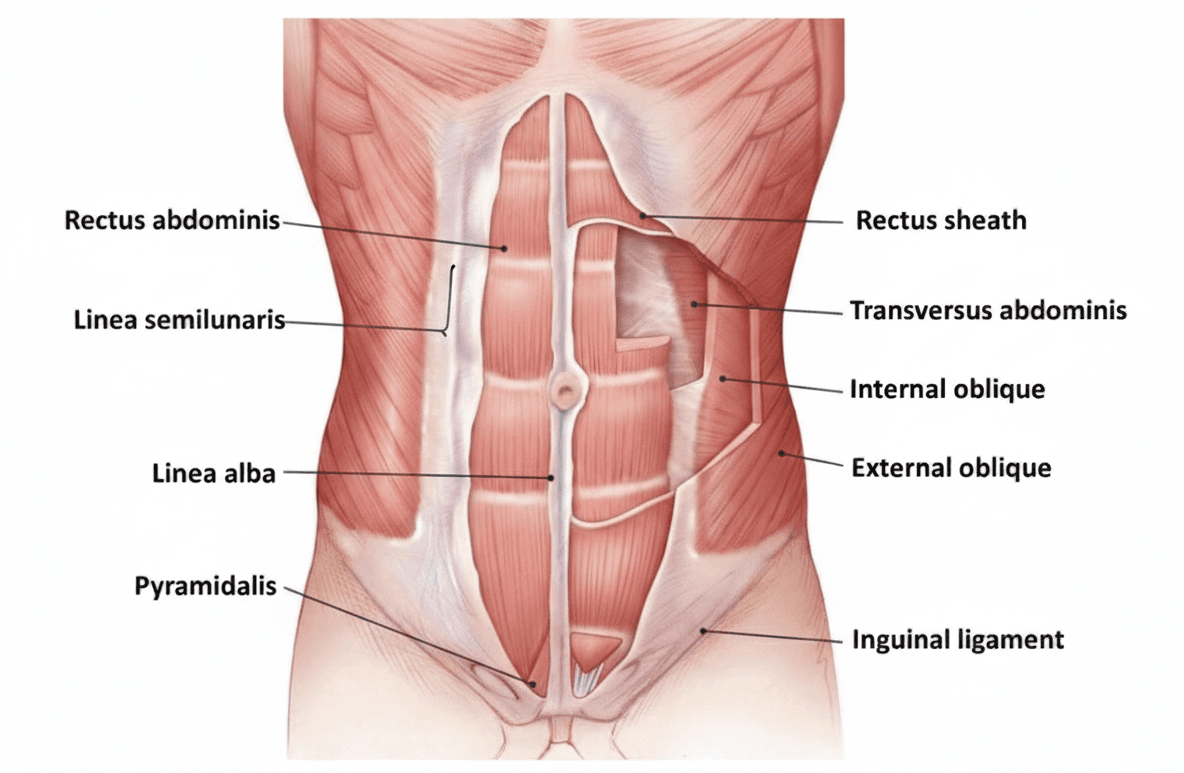
Anatomical illustration showing the core muscles including transverse abdominis, rectus abdominis, obliques, and back muscles highlighted in different colors
Key Takeaways
- Your core is a 360-degree system of muscles, not just your abs-engaging it properly means coordinating your breathing with gentle bracing, not sucking in your stomach
- Different activities require different levels of core engagement-from automatic during walking to conscious bracing during heavy lifting
- Start with breathing exercises and progress gradually through dead bugs, planks, and bird dogs to build functional core strength safely
#What Your Core Actually Is
Your core is not just the visible "six-pack" muscles. It is a 360-degree system of muscles that work together to stabilize your spine: the diaphragm on top, pelvic floor at the bottom, abs in front, lower back muscles behind, and obliques on the sides.
The Deep Team (Your Foundation)
- Transverse Abdominis (TVA): Your deepest ab muscle, wrapping around your torso like a corset - your body's natural back brace.
- Multifidus: Small muscles along your spine providing stability between vertebrae.
- Pelvic Floor: The hammock of muscles at the base of your pelvis.
- Diaphragm: Your primary breathing muscle, crucial for core stability.
The Surface Squad (Your Movers)
- Rectus Abdominis (the "six-pack"), Internal and External Obliques, Erector Spinae.
#Core Engagement Starts with Breathing
Proper core engagement begins with your breath. Your diaphragm and pelvic floor work in sync: on the inhale the diaphragm moves down and the pelvic floor relaxes slightly; on the exhale both gently lift.
Basic Core-Finding Exercise:
- Lie on your back, knees bent, one hand on chest, one on belly
- Breathe in, letting your belly expand
- As you exhale, gently draw your belly button toward your spine - imagine zipping up tight jeans
- Feel a gentle, deep tightening - not a hard clench of surface abs
Think of proper engagement as wearing a wide belt snugly, not tightly - supportive but not restrictive.
#Not Too Much, Not Too Little
Signs of over-bracing: holding your breath, neck and shoulder tension, headaches, feeling like you cannot move freely.
Signs of under-engaging: lower back arching excessively, feeling unstable, belly pushing outward (doming), lower back discomfort.
Your core should turn on and off as needed - constant tension causes fatigue and restricted breathing.
#Engagement Levels for Different Activities
Heavy lifting: Use the 360-degree breath technique - take a moderate breath (not maximum), brace as if someone is about to punch your stomach, maintain tension through the lift, exhale at the hardest part.
Cardio or light movement: Maintain about 20-30% tension, keep breathing rhythmically.
Daily activities (walking, sitting): Your core should work reflexively and automatically without conscious effort - save conscious engagement for lifting, carrying, or quick movements.
#Common Core Myths
- "Engage your core" means suck in your stomach - False. Sucking in turns OFF your deep core muscles. Think "brace," not "hollow."
- A strong core means visible abs - False. Visible abs are about body fat percentage, not functional strength.
- Core work means crunches - False. Your core works hardest resisting movement (planks) or transferring force (carries).
- Keep your core tight all day - False. Constant tension leads to fatigue and restricted breathing.
Gear for this article
Curated tools & essentials mentioned in this guide

#Progressive Core Activation Drills
- Weeks 1-2: Dead Bug Prep - Lie on back, find neutral spine, exhale to gently engage core, lower one heel while keeping back still.
- Weeks 3-4: Modified Plank - On hands and knees, engage with exhale, walk hands forward until core works, hold 10-20 seconds while breathing normally.
- Weeks 5-6: Bird Dog - On hands and knees, extend opposite arm and leg slowly, hold 5 seconds, return with control.
If basic core engagement causes pain or you notice doming in your abdomen, consider seeing a physical therapist specializing in core rehabilitation.
Recommended Gear
Challenge core engagement during planks and create unstable surface for exercises
Progressive core training tool that demands proper bracing technique
Dual-sided discs for dead bugs, mountain climbers, and dynamic core work
Improve thoracic mobility and breathing mechanics for better core engagement
Comfortable padding for floor-based core exercises like dead bugs and planks
Add progressive resistance to pallof press and anti-rotation core exercises
Unstable surface challenges core stability during any exercise