
Exercise Through the Ages: What Changes and What Doesn't
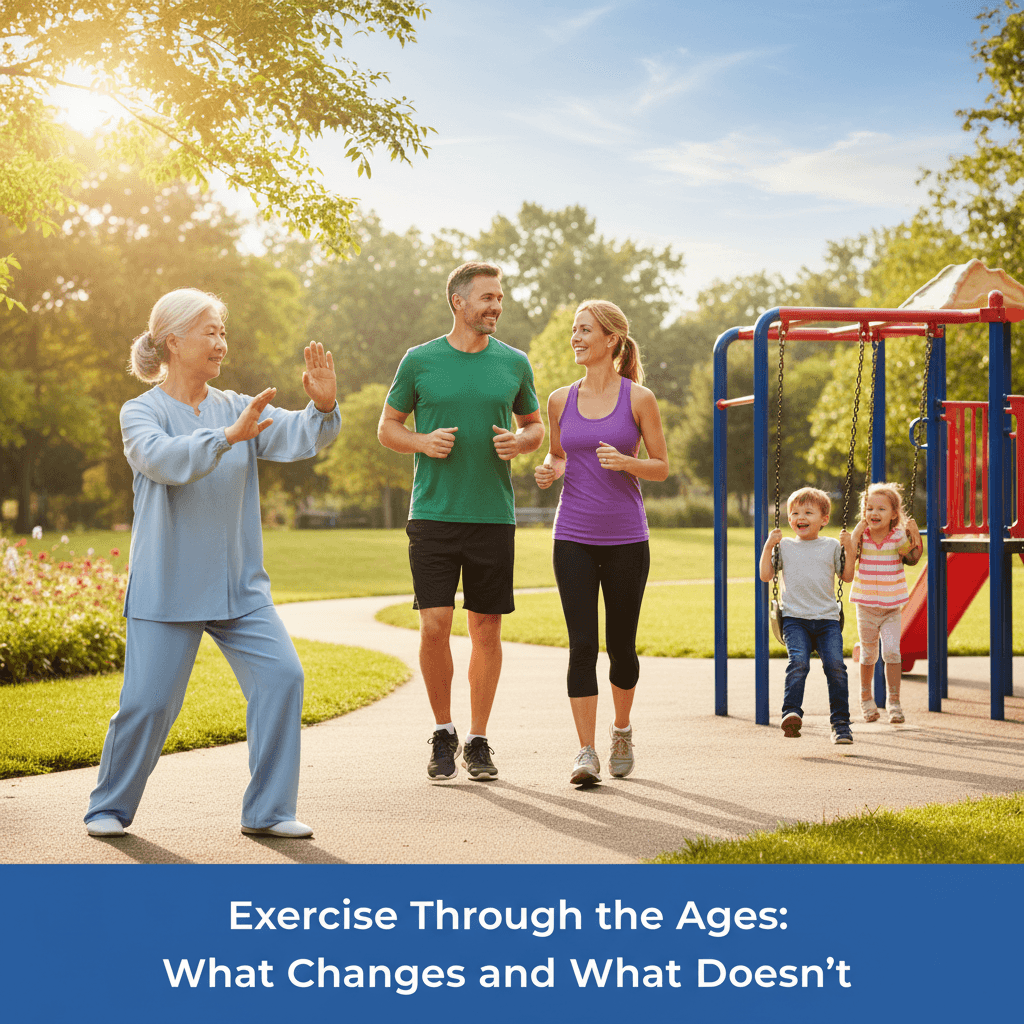
Three generations exercising together in a park - a grandmother doing tai chi, parents jogging, and children playing actively
Key Takeaways
- Exercise principles remain the same across ages, but application and recovery needs change - adjust frequency and intensity, not enthusiasm
- Strength training becomes increasingly critical with age to combat muscle loss and maintain bone density
- Every age has unique advantages - use them strategically rather than fighting against natural changes
#What Never Changes
Regardless of age, three principles hold constant:
- Progressive overload works the same whether you're 18 or 80. Muscles grow stronger when challenged appropriately - the weight may differ, but the principle is universal.
- Consistency beats intensity at every age.
- Recovery is non-negotiable.
Exercise becomes more important as we age, not less - because it actively combats the natural declines that accumulate over decades.
#20s and 30s: The Foundation Years
Peak bone density, maximum muscle potential, fastest recovery times. Use them.
Smart moves:
- Learn proper form now - it is harder to unlearn bad patterns later
- Build bone density through weight-bearing exercise
- Establish consistency before life gets complicated
Common mistakes: Feeling invincible, skipping warm-ups, ignoring minor injuries.
Weekly framework: 3-4 strength sessions, 2-3 cardio, 1 flexibility session, 1 full rest day.
#40s and 50s: Maintenance and Adaptation
Your body sends signals it used to absorb silently. Time to listen.
What is changing: Gradual muscle loss begins, metabolism slows 2-4% per decade, hormonal shifts affect recovery, joint wear becomes noticeable.
Common mistake: Trying to exercise like you're still 25. Ego-driven intensity at this stage is the main injury driver. Work smarter, not just harder.
Smart moves: Longer warm-ups (10-15 minutes), more flexibility and mobility work, strength training 2-3x per week.
Weekly framework: 2-3 strength sessions, 2 cardio, 2 flexibility/mobility sessions, 1-2 rest days.
#60s and Beyond: Optimization
Primary focus: functional fitness for daily activities. This is not about slowing down - it is about being strategic.
What is changing: Muscle mass decreases 3-8% per decade (faster after 60), balance needs active work, bone density drops.
Smart moves: Water-based exercises, resistance bands, tai chi or dance for balance, group classes for social connection.
Weekly framework: 2 strength sessions, 2-3 low-impact cardio, 2 balance/flexibility sessions, 2 rest or active recovery days.
#Recovery Time by Decade
Recovery time increases with age - this is not weakness, it is physiology:
- 20s: 24-48 hours for full recovery
- 40s: 48-72 hours typically needed
- 60s+: 72-96 hours for intense sessions
Slower adaptation in older adults comes from three factors: longer recovery time + hormonal changes + increased injury risk. The solution is to adjust frequency, not enthusiasm.
#The Hormonal Factor
- Testosterone declines approximately 1% per year after 30 (not 10%) - strength training helps maintain levels.
- Growth hormone decreases with age; high-intensity exercise and good sleep boost production.
- Estrogen decline (women) affects bone density and muscle mass - weight-bearing exercise becomes even more critical.
#The Mental Game Changes Too
Exercise motivation naturally shifts across life stages:
- 20s-30s: Appearance, performance, and social aspects
- 40s-50s: Health, stress relief, and setting an example for kids
- 60s+: Independence, social connection, and cognitive health
Use the motivation that fits your life stage - it is all valid.
Gear for this article
Curated tools & essentials mentioned in this guide


#The Never-Too-Late Principle
Research shows people in their 90s can still build muscle. Bone density can improve at any age with weight-bearing exercise. Balance can be retrained regardless of age. A 65-year-old beginner often sees more dramatic improvements than a 25-year-old because they are starting from a different baseline.
Age is data, not destiny. The goal is to be the strongest, most capable version of yourself at every stage - movement always matters.
Recommended Gear
Safe strength training at any age with adjustable resistance from light to heavy
Low-impact cardio with back support ideal for joint-friendly exercise at any age
Improve stability and prevent falls with versatile balance exercises for all ages
Progressive overload strength training with one space-saving set that grows with you
Support longer warm-ups and recovery needed as you age for continued mobility
Make stretching accessible at any flexibility level for maintaining mobility with age
Perfect starting weights for beginners or those returning to strength training at any age