
Cardio vs Strength: Why It's Not Actually a Competition
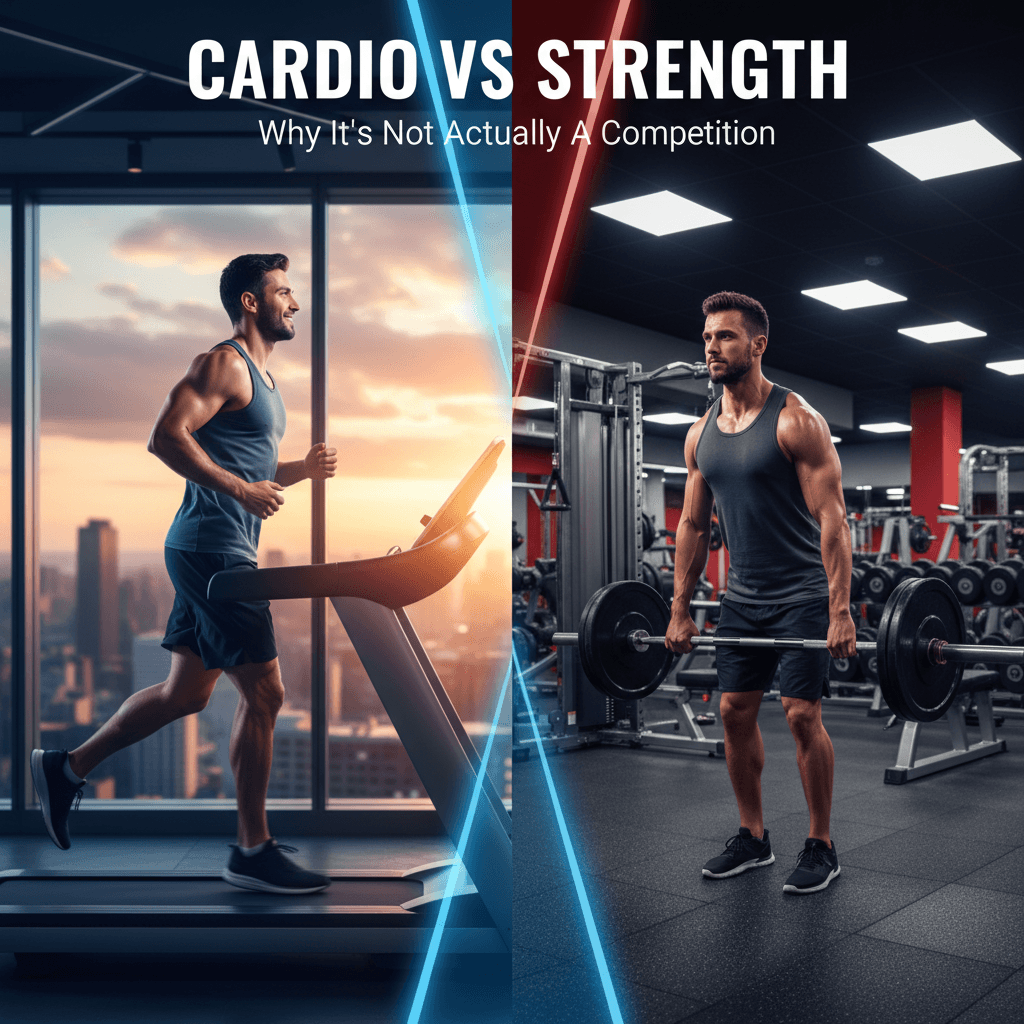
Split image showing a person running on one side and lifting weights on the other, merged in the middle to show both activities can coexist harmoniously
Key Takeaways
- Cardio and strength training are complementary, not competitive - combining both produces superior health and fitness outcomes
- The 'interference effect' is only a concern for elite athletes - beginners benefit from doing both types of exercise
- Start with WHO guidelines: 150 min moderate cardio + 2 strength sessions weekly, then adjust based on your goals and preferences
Fitness culture often frames cardio and strength as competing choices. The debate is based on a false premise - you don't have to pick one. Both belong in a balanced routine, and they work better together than either does alone.
#The Myth of Mutual Exclusivity
Labeling yourself a "cardio person" or a "strength person" is limiting and doesn't match how the body works. Squatting improves your running efficiency; building cardiovascular endurance improves your recovery between strength sets. These are complementary systems.
#What Each Type Actually Does
#Cardiovascular Exercise
Cardio trains your heart, lungs, and circulation - but its benefits extend to your muscles too:
- Heart efficiency: stronger heart, more blood per beat
- Oxygen utilization: muscles extract and use oxygen better
- Mitochondria: cellular powerhouses multiply in muscle cells
- Recovery: your body clears metabolic waste faster, improving strength-set recovery
#Strength Training
Beyond building muscle, strength training delivers broad metabolic benefits:
- Bone density: stimulates bone growth, prevents osteoporosis
- Metabolic health: increases insulin sensitivity and glucose uptake
- Joint stability: strengthens connective tissue
- Sarcopenia prevention: slows age-related muscle loss
#The Interference Effect - Overstated for Most People
You may have heard that cardio "kills gains" or lifting makes you "too bulky to run." The interference effect is real, but only matters when:
- You're training at elite athletic levels
- You're doing high volumes of both back-to-back without adequate recovery
- You're trying to maximize opposing disciplines simultaneously
For 99% of people - beginners and intermediates included - combining both produces superior results compared to doing either alone.
#Why You Need Both
Real-world tasks rarely demand only one quality. Helping a friend move illustrates this perfectly: you need strength to lift furniture and endurance to climb stairs repeatedly without getting winded. Pure cardio or pure strength leaves you half-equipped.
For fat loss specifically, the combination is the most effective strategy - cardio creates a caloric deficit and improves fat oxidation, while strength training preserves muscle mass and keeps your metabolism elevated.
Gear for this article
Curated tools & essentials mentioned in this guide


#WHO Recommendations
The World Health Organization recommends both:
- 150 minutes of moderate cardio OR 75 minutes of vigorous cardio per week
- 2+ strength sessions per week hitting all major muscle groups
These are both minimum targets, not either/or options.
#The Training Spectrum
Think of training as a full spectrum rather than a binary choice:
- Power - Olympic lifts, sprints
- Strength - heavy resistance training
- Hypertrophy - moderate weight, higher volume
- Muscular Endurance - light weights, high reps
- Anaerobic Conditioning - intervals, circuits
- Aerobic Conditioning - steady-state cardio, walking
- Recovery - gentle movement, stretching
A complete fitness approach draws from multiple points on this spectrum.
#A Simple Starting Point for Beginners
One balanced weekly structure: 3 full-body strength sessions + 2-3 moderate cardio sessions + 1-2 rest or light-activity days. Adjust once you're consistent. The exact order (cardio before or after weights) matters less than showing up regularly.
Stop choosing sides. Include both.
Recommended Gear
Build strength at home while maintaining your cardio routine
Combine cardio conditioning with coordination training in one tool
Track intensity across both cardio and strength training sessions
Perfect hybrid tool for combining strength and cardio in one workout
Versatile equipment for both strength circuits and cardio intervals
Cushioned surface for floor-based strength and cardio exercises
Program circuits that combine cardio bursts with strength exercises